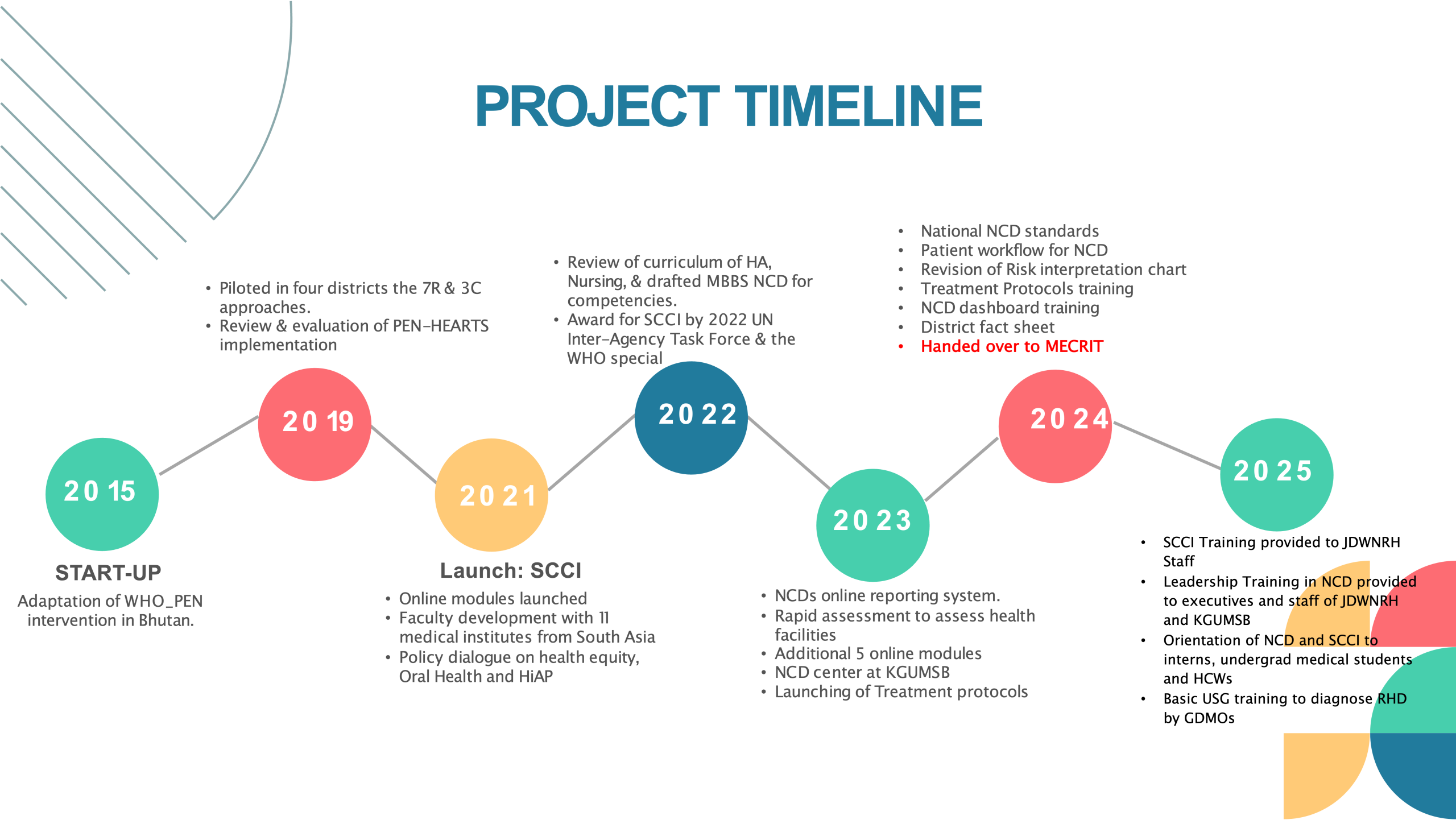
The Service with Care and Compassion Initiative (SCCI) is a national effort to strengthen the prevention and management of Noncommunicable Diseases (NCDs) across Bhutan. Building on the WHO Package of Essential Noncommunicable (PEN) Disease Interventions introduced in 2015, SCCI aims to ensure comprehensive, continuous, and coordinated care for patients living with chronic conditions.
Following the 2016 PEN clinical audit, important gaps were identified in service delivery, including inconsistent adherence to treatment protocols, inadequate follow-up of patients, limited monitoring of hypertension and diabetes control rates, and weak referral coordination between health facilities. To address these challenges, the Ministry of Health (MoH), with support from the World Health Organization, implemented the PEN HEARTS package in selected districts. This introduced the “7 R and 3 C” approach—focusing on robust teams, reliable refills, responsive referrals, real-time monitoring, and coordinated chronic care.
In 2021, these interventions were expanded under the SCCI framework, integrating stroke care, early cancer detection, and palliative care into the broader NCD service spectrum. By the end of 2021, nine districts were covered, with plans to scale up to 20 districts through a three-way partnership between the MoH, District Health Authorities, and the Khesar Gyalpo University of Medical Sciences of Bhutan (KGUMSB).
The SCCI reflects Bhutan’s commitment to equitable and compassionate health care delivery, especially for rural and remote communities. By combining technical standards, workforce capacity building, real-time monitoring, and academic leadership, the initiative aims to improve health outcomes and ensure sustainable, high-quality chronic care services nationwide.
Through this partnership, KGUMSB reinforces its mandate as a national leader in medical education, research, and health systems strengthening by supporting Bhutan’s journey toward resilient, people-centered healthcare.
As the country’s medical university, KGUMSB is uniquely positioned to integrate education, and research under one platform. Establishing the NCD Centre within the university ensures that updated clinical protocols and quality assurance mechanisms are embedded into both pre-service and in-service training. This approach strengthens workforce capacity in a sustainable manner rather than relying solely on short-term project-based interventions.
By situating the Centre at KGUMSB, routine service data can be systematically analyzed, translated into evidence, and used to inform policy, training, and continuous quality improvement initiatives. The academic environment further enables operational research and documentation of best practices.
The NCD centre also collaborates with ACCESS health international which supports in capacity building of the health care providers.
The NCD Centre will therefore serve as a hub for training, research, mentorship, and quality improvement, contributing to resilient, people-centered healthcare services across the country.